
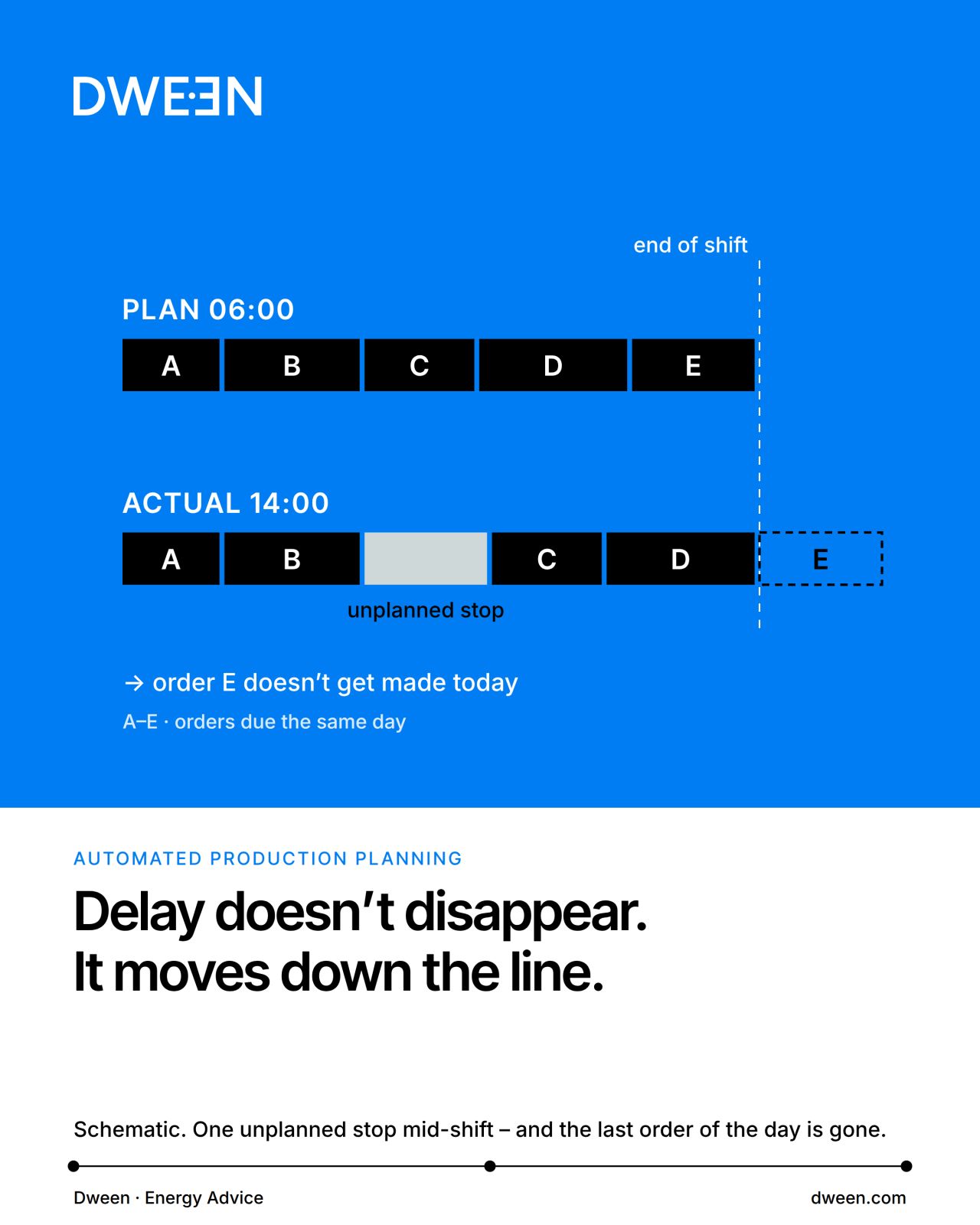
A production plan is usually accurate once a day – on the morning it was made.
By the afternoon it is no longer a plan. It is an account of how the day was supposed to look.
That is not the planner's fault. A plan is assembled from dozens of constraints: changeover times, recipe sequences, buffers between stages, material readiness, shift patterns. Putting them into one sequence takes hours.
So when a line stops mid-shift, or an urgent order arrives, nobody recalculates the plan. In the time available it simply cannot be done. The plan gets patched locally instead – calls to packing, to the warehouse, to quality.
And here is the part that matters: the delay does not disappear. It moves down the line, and whoever is last in the sequence pays for it.
This is the one thing Dween automated production planning does, and it does it fully. The constraints are written down once, and the plan is recalculated when reality changes – not when someone finds the time.
It does not replace the planner. It gives them the ability to replan the day when it needs replanning, rather than tomorrow morning.
One more thing we see in almost every plant: the rules that actually decide the sequence are not written down anywhere. They live in the heads of two or three people. Which is why only those same two or three people can build the plan.
A question for production managers: how long does it take to replan the day in your plant when one line goes down?
If the answer is hours, the plan is not really being recalculated. It is being patched.
For industrial companies
We offer critical digital twin capabilities that help maximize energy efficiency, sustainability and maintenance goals.
For Partners
We offer a self-service digital twin platform that helps you scale your business by delivering additional value to your key manufacturing and production clients.